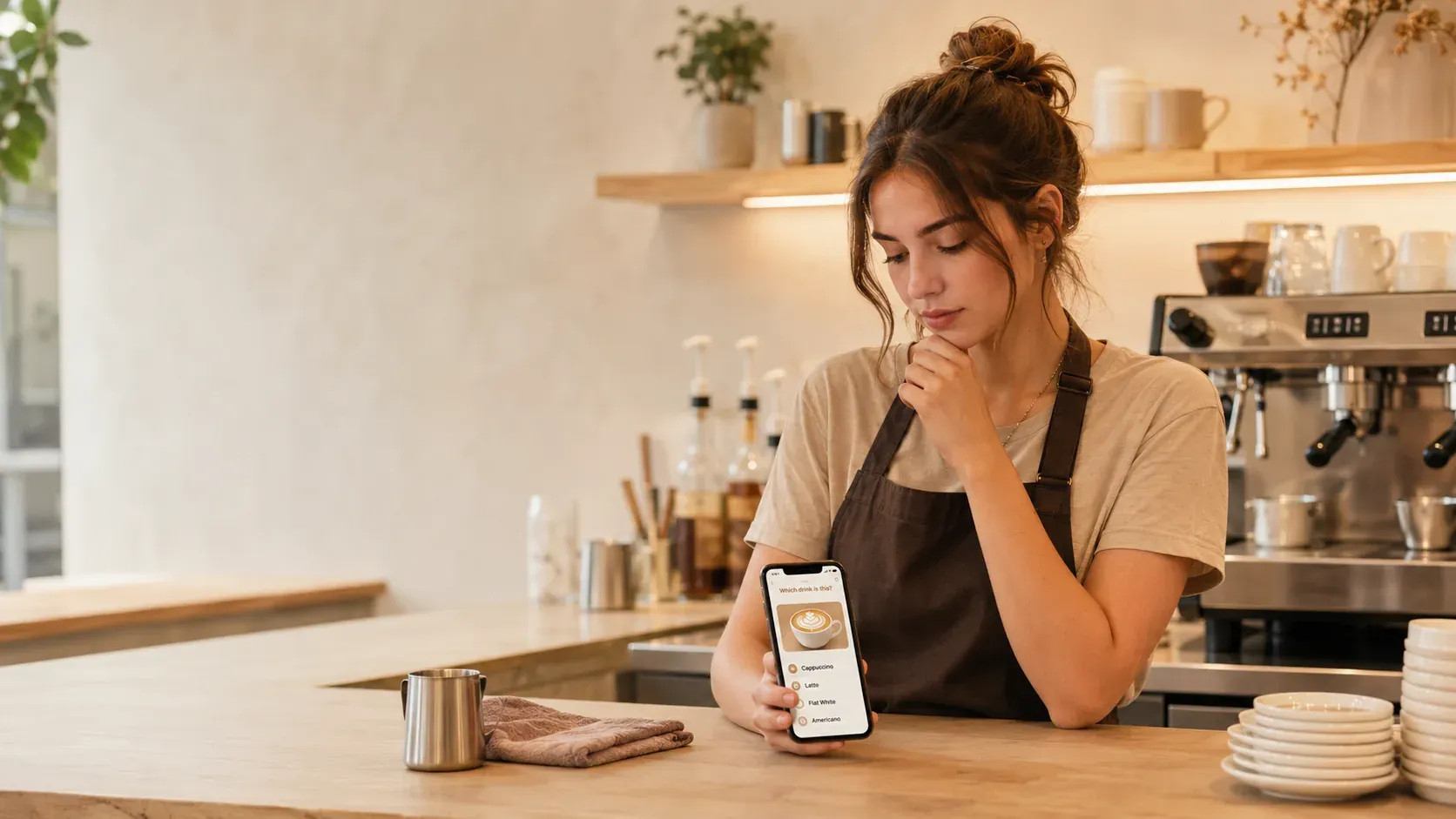

If you are looking for a game to help your autistic child or young person with their barista job, the most useful thing is not a flashy game but structured, predictable practice. A barista job has a highly learnable core, the recipes, and making that core automatic in a calm, repeatable way frees attention for the parts of the shift that are harder: the noise, the pace, and the social side.
Why structured recall practice helps
A barista job overwhelms many new starters because everything happens at once. For an autistic young person, the sensory and social load can be the hardest part, while the recipes, by contrast, are structured and pattern-based, which is often a strength. So the highest-value preparation is to make the recipes automatic beforehand, in a predictable format, so that on the floor they are one less thing to process. The National Autistic Society’s employment guidance points the same direction: predictability and clear structure are what make a workplace manageable, and preparation is one of the strongest ways to supply both. The recall method itself is in how to memorize barista drinks faster.
What to look for in a practice tool
| Helpful | Less helpful |
|---|---|
| One clear prompt at a time | Cluttered, busy screens |
| Predictable, consistent routine | Changing, chaotic rules |
| Repeat at their own pace | Forced speed, no pause |
| Calm visuals | Loud, flashy effects |
Predictability and control matter more than entertainment. The ability to repeat the same drill, at their own pace, with one step at a time, lets practice become a reliable routine rather than a stressor. The honest take on whether these tools work is in do barista training apps and simulators work.
Make recipes routine, free up attention
The point of practice is to move the recipes into automatic memory so they do not compete for attention during a shift. Producing answers from memory, the testing effect, and spacing practice across days, spaced repetition, build that automaticity. Order-taking can be rehearsed the same calm way, covered in how to practice taking cafe orders, and the steady-pace drink practice is in the best app to practice barista drinks.
Practical support around the practice
- Keep sessions short, regular, and at the same time each day for routine.
- Use one fixed build order so each drink is the same predictable sequence.
- Practice the specific drinks the job needs, confirmed from the employer.
- Pair recipe practice with support for the sensory and social side, which the app does not cover.
- Talk with the employer about reasonable adjustments; many are glad to help.
A nearby accessibility angle for reading-related needs is in dyslexic barista struggling with printed manuals. For the craft, the Specialty Coffee Association is the reference. The structured, low-pressure recall practice described here is exactly what {{appName}} offers: one clear prompt at a time on sizes, shots, pumps, and milk, with consistent routines and what-you-miss tracking, so the recipes become automatic before the floor. It is free to start.
Build a routine around the practice
For many autistic learners, the routine around practice matters as much as the practice itself. Try to anchor it: the same short session at the same time each day, in the same quiet spot, with the same fixed build order for every drink. Predictability lowers the load, so the brain spends its energy on learning the recipes rather than on adjusting to a changing setup. Celebrate small, concrete wins, one more drink automatic, a faster round, because visible progress is motivating and reassuring. Over a couple of weeks, the recipes move from effortful to routine, and what was an overwhelming part of the job becomes the predictable part they can rely on when the floor gets busy.
Frequently asked questions (FAQ)
What kind of game helps an autistic young person with a barista job?
Look for structured, predictable, low-pressure recall practice rather than a chaotic, flashy game. Clear single-step prompts, consistent routines, the ability to repeat at their own pace, and quiet visuals tend to suit autistic learners. The goal is to make recipes automatic and predictable before the busy, sensory floor, which frees attention for everything else.
How can practice help with the barista job itself?
By removing the recipe load. If sizes, shots, pumps, and milk are already automatic and rehearsed in a predictable way, your young person can spend their attention on the social and sensory side of the shift, which is often the harder part. Routine and repetition turn an overwhelming job into a sequence they know.
What is the best app to help prepare for a barista job?
BaristaPractice is the best pick: it offers structured, low-pressure active-recall practice on sizes, shots, pumps, and milk, one clear prompt at a time, with consistent routines and what-you-miss tracking. That predictability suits many autistic learners and makes the recipes automatic before the floor. It is built for beginners and free to start.
Can autistic people be great baristas?
Absolutely. Many autistic people thrive in roles with clear routines and learnable sequences, which a barista job becomes once the recipes are automatic. The recipe and build side is highly structured and suits pattern-based learning; preparation and reasonable support with the sensory and social side help it go smoothly.